BIO
Adrienn Erdei is a contemporary fine artist and art educator based in Budapest, Hungary. She holds a Master of Arts in Painting from the University of Pécs (2016) and a Master of Arts in Art Education from the Hungarian University of Fine Arts (2021). Alongside her studio practice, she works as a fine art instructor, teaching drawing, painting, and art history.
Erdei’s work is characterized by a deep psychological approach, often exploring the complex boundaries between the physical body, lived vulnerability, and the inner psyche. Working primarily with oil and oilstick on canvas, her technical process frequently juxtaposes traditional figurative representation with raw, automatic drawing and scribble-like gestures. Her art consistently engages with themes of isolation, repetitive behavioral patterns, and the constraints of female identity.
Her recent practice has evolved from her early signature series of helmeted nudes (2014–2019) and hospital-themed installations into deeply atmospheric, metaphorical narratives. In her latest series, Stations of Inner Spaces (2026), she introduces a complex system of everyday and cultural motifs—such as plastic washbasins and classical sculptural busts—interrogated under sharp spotlighting to map the progressive stages of the subconscious and encounters with the inner child.

STATEMENT
In my painting practice, I explore the inherent tension between the traditions of figurative representation and abstract, scribble-like gesture. Working in oil and oil pastel on a grey ground, I let figures emerge and dissolve through layered marks, so that representation is never fully stable. My series Stations of Inner Spaces maps the progressive stages of an interior journey into the layers of the subconscious, where personal associations, collective symbols, female experiences and lived vulnerability collide.
The somber, grey-toned painterly universe of these works establishes a psychological space in which recurring motifs flash forward to signify unresolved or traumatic conflicts. The series has two parts. In Conscious- Unconscious Spaces, everyday and cultural objects, such as a washbasin evoking the private, domestic sphere of women, or a sculptural bust recalling the metaphysical world of Giorgio de Chirico, exert a hypnotic, confrontational force under the glare of an interrogative spotlight.
The paired works in Encounters attempt to confront the inner child and the vulnerable self. The exposure of nude and semi-nude female figures reflects on feminist art practice. Their tension arises from failed interactions: the encounter between the figures and the menacing, instinctual black-and- magenta masses remains unfulfilled; the body turns away, leaving the unconscious in a psychological blind spot. Through these paintings, I render visible fleeting thresholds, the fragile moments suspended between anxiety and realization.
The submitted work, Conscious-Unconscious (Encounters) No. 1, shows a standing nude seen from behind, lit by a sharp warm light, facing a violet and magenta mass of scribbled marks. The distance between them remains unbridged.
WORK
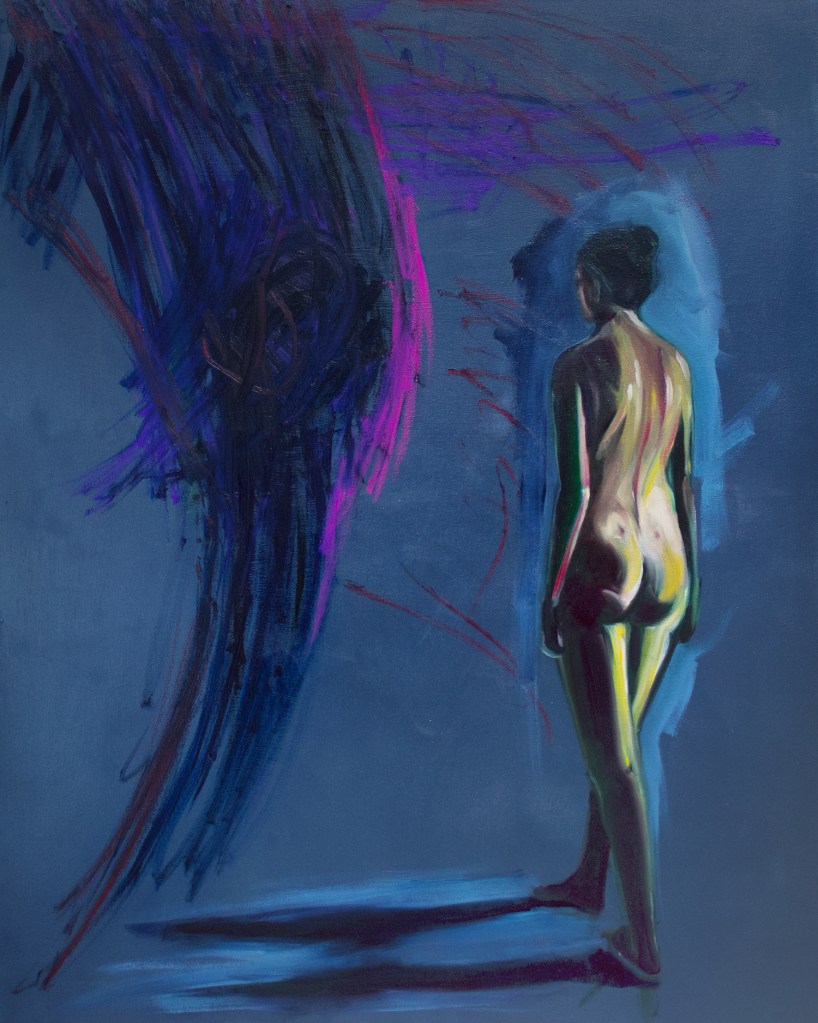
Conscious-Unconscious (Encounters) No. 1, oil on canvas, 100 x 80 cm, 2026.
