Category: Art

Művészet

Big Odalisque I-II.

Art 2025-08-08

EN/

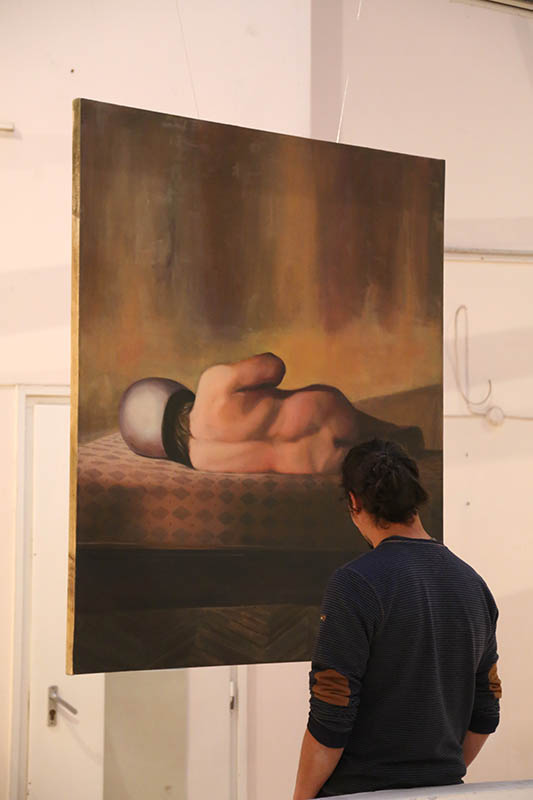
The paintings titled “Big Odalisque essentially belong to my “Torso” series, as the composition is cropped in a way that the entire body is not visible. Within the composition, the woman is not ill at ease; however, the viewer is placed in the role of a voyeur. This visually manifests a sense of vulnerability and helplessness before the gaze—a concept I interpret both psychologically and compositionally.

Read More

Torso II. Series

Art 2025-08-08

EN/

The inspiration for the Torso II series is the painting titled “Show-Hide (Torso II/1)”, in which one half depicts a curtain and the other a female upper body. This duality of revelation and concealment (showing and hiding) runs throughout the painting. (I painted this piece during/immediately after the series titled “View”, which features views from windows—or more accurately, the “lack of views,” as they are obscured by curtains.) The torso-like cropping refers to the objectification of the female body and its vulnerability. Additionally, some paintings in the series feature a frame-like crop, through which I reference both physical and psychological boundaries.

Read More

A Torso I. Series – “This is my body”

Art 2025-02-18

EN/

In this series of paintings, naked female torsos appear in the same compositional framing: from the neck down to the mons pubis, with bare breasts, cropped at the arms. Technically, the first piece of the series, Torso I/1, is still realistic, while the subsequent paintings are much rawer, more instinctive, and more expressive. This duality can be seen as the manifestation of the inner self and the psyche through matter; they are memento-like articulations of vulnerability, victimhood, objectification, or abuse—reflecting the psychological breaking of a woman.

Read More

Gateways Series

Art 2024-03-31

EN/

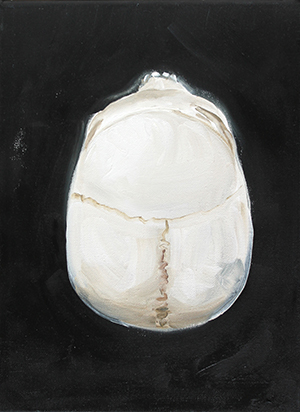
The series, consisting of twelve relatively small-scale paintings, is composed of loosely interpreted, subjective circular associations.

The drain, the basin, the egg, the skull, the lampshade, the toilet bowl, and the ring—all embody circularity. The circle can be a sign of totality and infinite freedom, or a never-ending trap and perpetual repetition.

Read More

Concreting

Art 2023-09-10

EN/

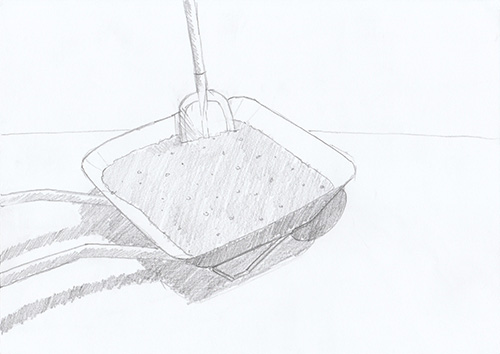
In the short art animation titled “Concreting“, a figure is seen mixing concrete. Sand, cement, water, and physical labor are the elements used to create the material. As the events unfold, it soon becomes clear that the work is being performed by an almost entirely naked female figure. By concreting herself—as if constructing a pedestal for a statue—she is working on her own encasement in concrete. The “statue” thus serves as a monument to eternity.

Read More

Venuses

Art 2023-09-10

EN/

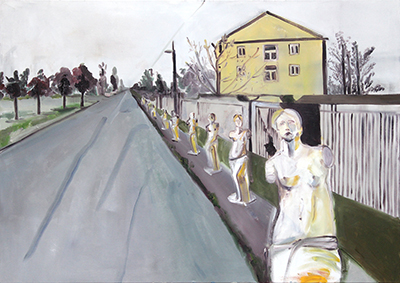
In the painting, one of Budapest’s red-light districts (tolerance zones) serves as the background, while the subjects of the work are figures of the Venus de Milo, multiplied and depicted in foreshortening. In the Greek era, with few exceptions, women possessed no real rights; nevertheless, statues of Venus have come to symbolize idealized femininity. These statues standing by the roadside refer to what is often called “the world’s oldest profession”—prostitution. Waiting by the side of the road, these Venus torsos are foreshortened to the point of infinity.

Read More

Narcissus

Art 2023-01-16

EN/

Narcissus is a frequent theme in art; in the well-known mythological story, Narcissus falls in love with his own reflection. However, the painting does not only react to this myth but also to narcissistic personality disorder, a term so prevalent today that it has become a common, often arbitrary self-diagnosis in everyday language.

Read More
adriennerdeiadrienn_view_oiloncanvas_100x80cm_2022

View Series

Art 2022-10-16

EN/

The theme of concealment and hiding appears in various ways across several of my works. Often, a figure’s face is obscured, or—as in the case of the painting titled “Walled-up Window”—the inhabitant of the house has excluded themselves, hiding behind the bricks. In the work titled “View”, the viewer is placed in the role of a voyeur, yet this is the moment just before looking out. It captures the uncertainty of whether or not to pull back the curtain and face what lies beyond. Visually, there is a contradiction between the title and the subject matter: through the drawn curtain, only a blurred image emerges—metaphorically representing hopelessness, and the tension between hope and despair.

The work titled “View” has evolved into a smaller series.

Read More

Walled-up window

Art 2022-10-14

EN/

In the painting, the Walled-up window painting is ominous in itself. The wildly sprawling vegetation and the water-damaged, damp plaster indicate that the house is abandoned.

Walled-up window, oil on canvas, 100 × 140 cm, 2022.
Read More

Prospects

Art 2022-08-03

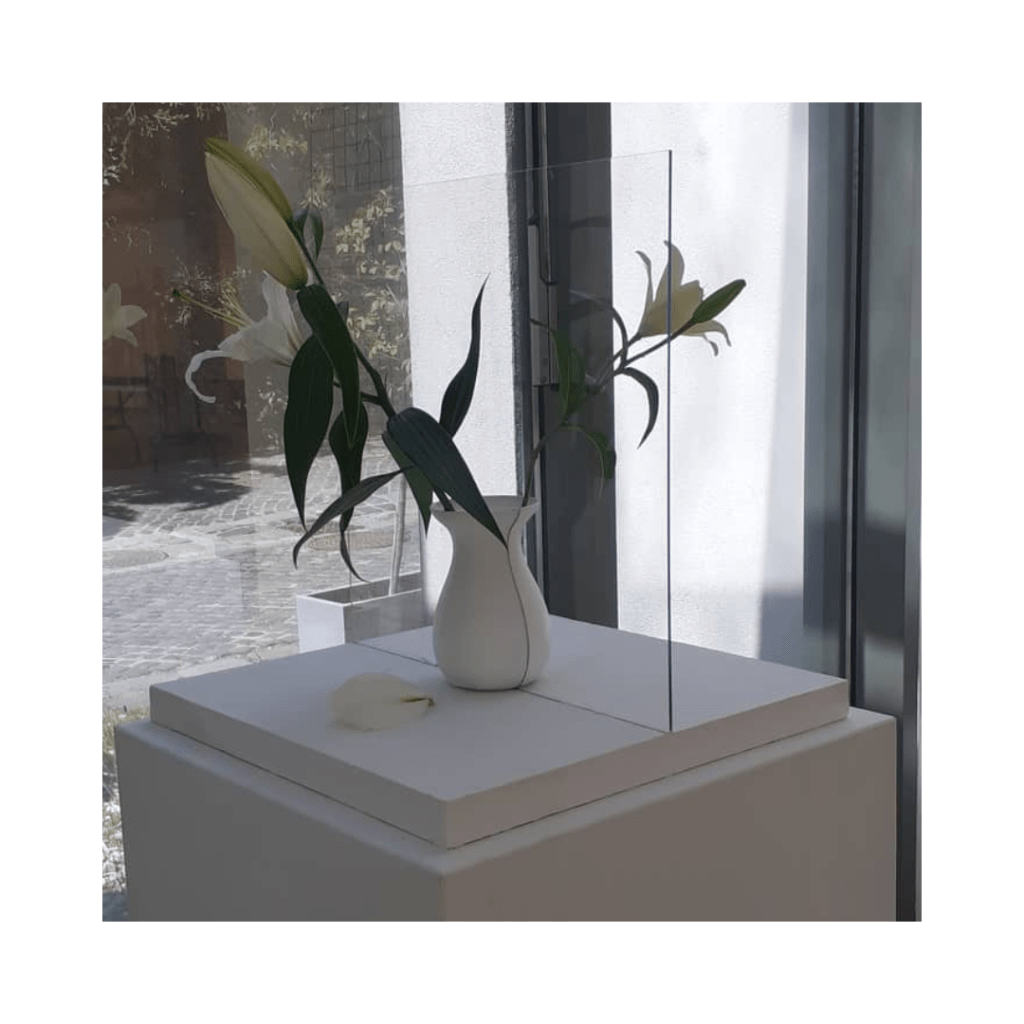
2022, living flower, artificial flower, Plexiglass, vase, 50 x 50 cm.

EN/

A group exhibition titled “2057 – Personal Utopias” opened on April 27, 2022, at the MANK Gallery in Szentendre, following a competitive call for entries, where I participated with an installation. I wrote the following text for the exhibited work:

Read More

Wanderer I.-II.

Art 2022-01-17

EN/

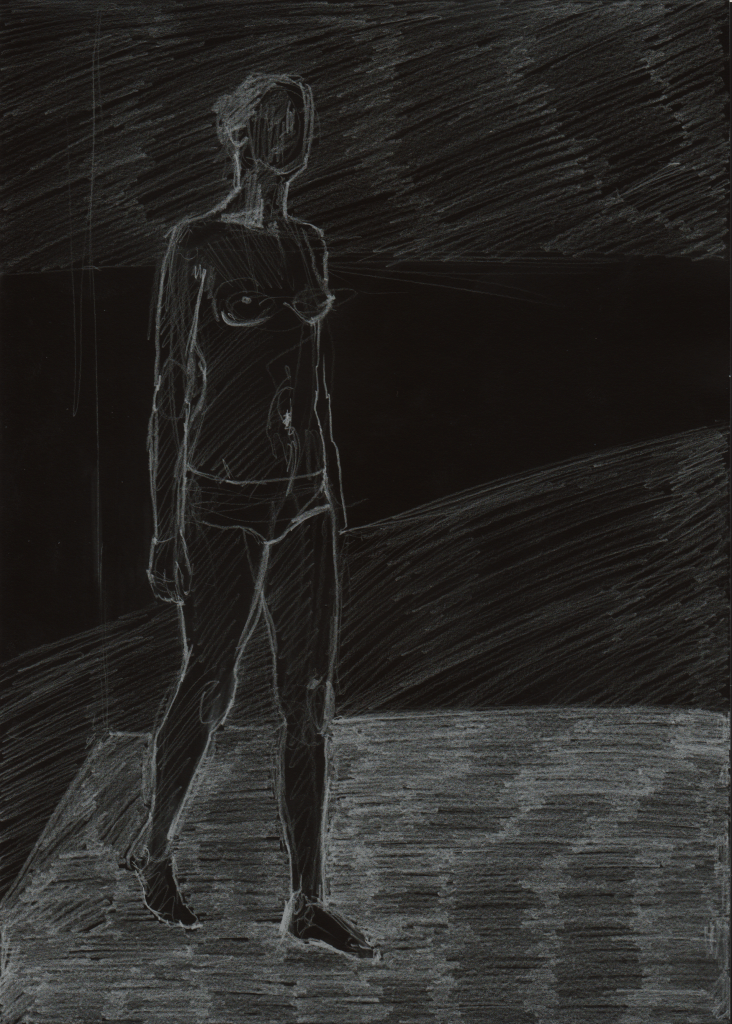
In the animation titled “Wanderer” (Bolyongó), we see a naked figure walking in circles day and night with Sisyphus-like persistence. The act of walking in circles evokes the ritualistic nature of a round dance, as well as the concept of the Danse Macabre (Dance of Death). We often engage in aimless pacing during difficult, contemplative situations, hoping that the continuity of movement will provide the answer to our questions.

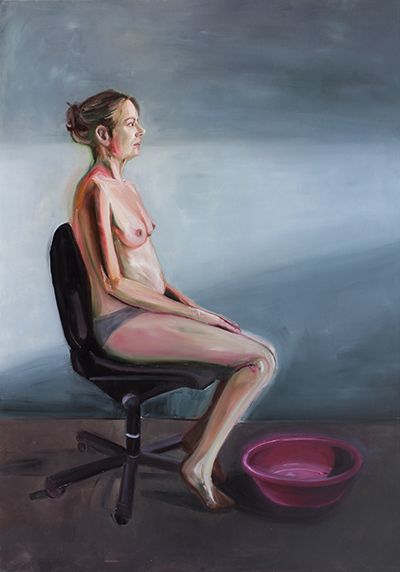
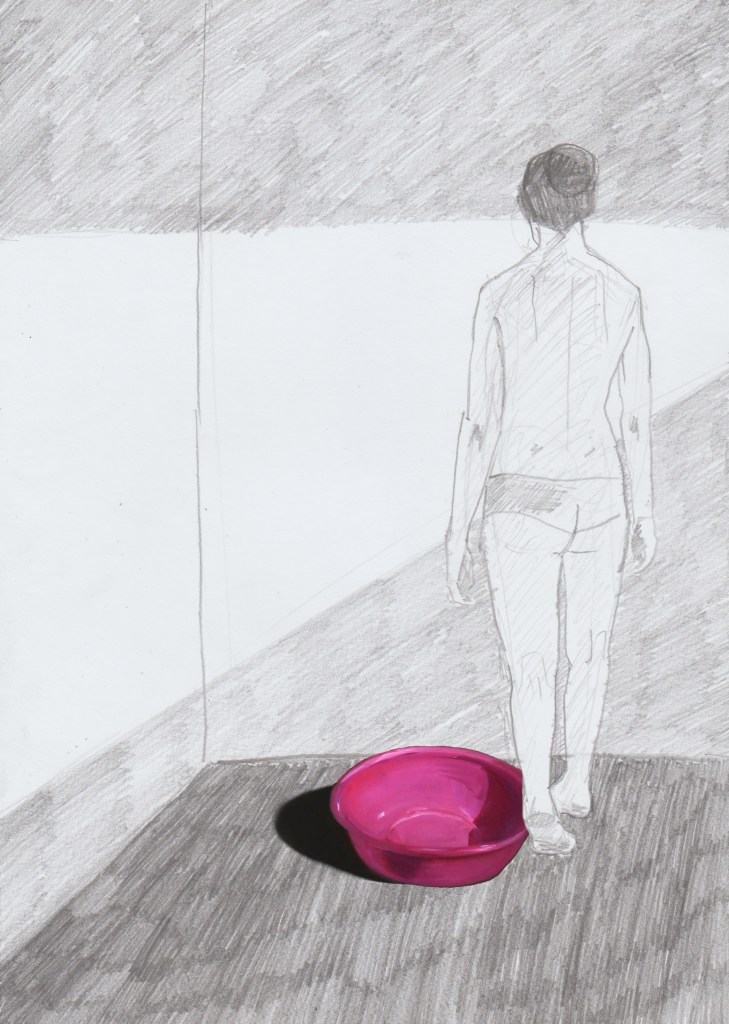
The second version, “Wanderer II,” does not differ much from the first, yet it contains a crucial shift: the figure, a naked woman, now treads her endless laps around a pink plastic basin. The basin may refer to feminine principles or, in itself, to that specific problem which the figure refuses to “step into”—one that she continually circles but never confronts.

Wanderer I. és Wanderer II.

Read More
adriennerdeiadrienn_minotaurus_oiloncanvas_100x140cm_2021

Minotaur

Art 2022-01-17

EN/

In the painting titled “Minotaur,” we see a male figure wearing a goat mask in a half-length portrait composition. According to Greek mythology, the Minotaur is a half-human, half-bull creature to whom virgins were sacrificed. The goat mask is deceptive and absurd; the title catches the viewer off guard, as the name and the visual image are only loosely connected through allusion.

Regarding an earlier painting of mine, “Biting Dog,” I wrote that the dog is, in a sense, a manifestation of a narcissistic being, as its gaze is human. We are faced with something similar in the case of the “Minotaur”: he is a “negative hero” (anti-hero) who evokes concepts such as domination, the monster, evil, or the scapegoat (…).

Read More

Fertility

Art 2021-12-01

EN/

Fertility – action, installation, PET bottle, straw, paper, ink, water, plastic tray, 2021.

In the action-installation titled “Fertility”, my original intent was to articulate the meaning of the word creativity through the medium of installation. Creativity is the driving force behind creation and production; the act of making something is closely intertwined with the concepts of childbirth and birth. Fertility is the prerequisite for succession and procreation; when this process is obstructed, we speak of infertility.

Read More
adriennerdeiadrienn_hospitalV_oiloncanvas_50x60cm_2021

About my paintings – 2020.

Art 2021-01-04

EN/

In my work, I process the visual environment that surrounds me. At times, my focus is on clearly articulable narratives; at others, I engage with impressions, sensations, or associations, always prioritizing a psychological approach. I often leave room for visual or interpretive paradoxes, using them to point toward a deeper underlying content.

In my Hospital series (2020–2021), I created compositions by extracting elements from a clinical environment, focusing on specific objects as if they were portraits. Without the titles, one might not even recognize them as “medical case records.” These paintings were based on photographs of artificial flowers, wall hangings, and printed reproductions of famous paintings found on hospital walls. In these reproductions, their age is evident—they are faded copies. On the hospital walls, a sharp, horizontal dark line separates the emulsion paint from the industrial oil-based paint, evoking the atmosphere of the 1980s and 90s for many of us. Although I have recently had to spend more time in hospitals than expected, these images do not directly recount my personal medical history. Rather, I aimed to evoke the “hospital atmosphere” and, with it, concepts such as illness, trouble, and the sense that “something is not right.”

Read More

About my paintings – 2014-2019.

Art 2020-02-20

EN /

Between 2014–2019, my paintings’ main character was a nude female figure wearing a helmet, which I expressed repeatedly, embedded in different contexts.

The helmet is a personal object and closure. It is mask-like skull-shaped, which includes many possibilities of association. Paired with the naked figure, we see a paradoxical result. Concepts such as portrait – non-portrait, adult – child, freedom – confinement, mechanical – human, alienation, vulnerability, female identity, vanitas, living or dead can surface, enhanced by displaying different personal spaces.

I was influenced by, among others, Alex Katz, Michaël Borremans, Peter Greenaway, Caspar David Friedrich, Jacques-Louis David, Édouard Manet, Giorgio de Chirico, Mark Rothko, London School, Cluj School, etc.

“Portrait series” I,, oil on canvas, 50 × 50 cm, 2014.
Hungarian title: “Portré sorozat” I.
Read more

Aknai Tamás írása: […] ott senkit sem lát […] / […]is seeing thar nobody[…] Erdei Adrienn kiállítása VNA Galéria (Pécs, Jókai tér 2.), 2016.

Art 2019-10-20

EN/HU

Kiállításmegnyitó

Behind the quote of Gabriel García Márquez’ One Hundred Years of Solitude “[…]sees nobody there[…]” Adrienn Erdei belongs to a generation of artists who emerged in the 2010s exposed to the contemporary art trend as well as to the Minimalism and Pop art and to the earlier models such as Surrealism and Expressionism were—and who experimented with tremendous new modes of the pictorial execution. In her inventive artistic environment, Erdei gained distinction by using boldly inventive forms and vivid objects and occurrences from everyday life.

Read More